Co-authorship and acknowledgement are forms of recognition for direct contributions to a work. I want to elaborate on the policy I follow, influenced by the groups were I have worked.
I essentially agree with this blog post, which is well-written: https://ramblingsofanecologa.wordpress.com/2020/11/10/who-should-be-a-co-author-rules-and-etiquette-of-academic-authorship/
There are multiple aspects of how to contribute to a paper: “conceiving the idea, designing the study/experiment, collecting the data, analysing the data, writing the manuscript”.
Acknowledging experiment design in astronomy
It is sort of obvious that you should offer co-authorship to someone who gave you the idea for the study you are executing. Unfortunately, there are people in astrophysics who take data and ideas from others without credit. One second-hand horror story from decades ago is that a young postdoc was giving a presentation in CalTech about an idea to observe M-dwarf spectra for the first time, and laying out a strategy to achieve it. During question time, a senior researcher said: “That’s a great idea! I’m gonna do that.” Another second-hand horror story is that a member of the NICER instrument team used his privileged position to monitored ad-hoc transient observing proposals (where the data go public immediately) and scooped people’s work. This became so bad that in transient conferences, people would hide their source coordinates; yet the person once went up to a speaker saying “Don’t think that just because you hide the coordinates I can’t find your source.”. We must not let these behaviours proliferate. Do not hire these people.
It is less obvious how to credit someone who enabled the data sets that your study builds upon.
At the start of my career I have underestimated the effort people put in writing observing proposals. This experiment design work is crucial and enables scientific studies. So if the data is public, it is professional to ask the PI of the observing proposal, if they have not published a paper on the observations yet, whether they would like to be co-authors. This would probably not apply if it has been more than 2-3 years since the data were taken, but funding issues, or a PhD student dropping out can delay data exploitation significantly. If you know the PI, you should always ask.
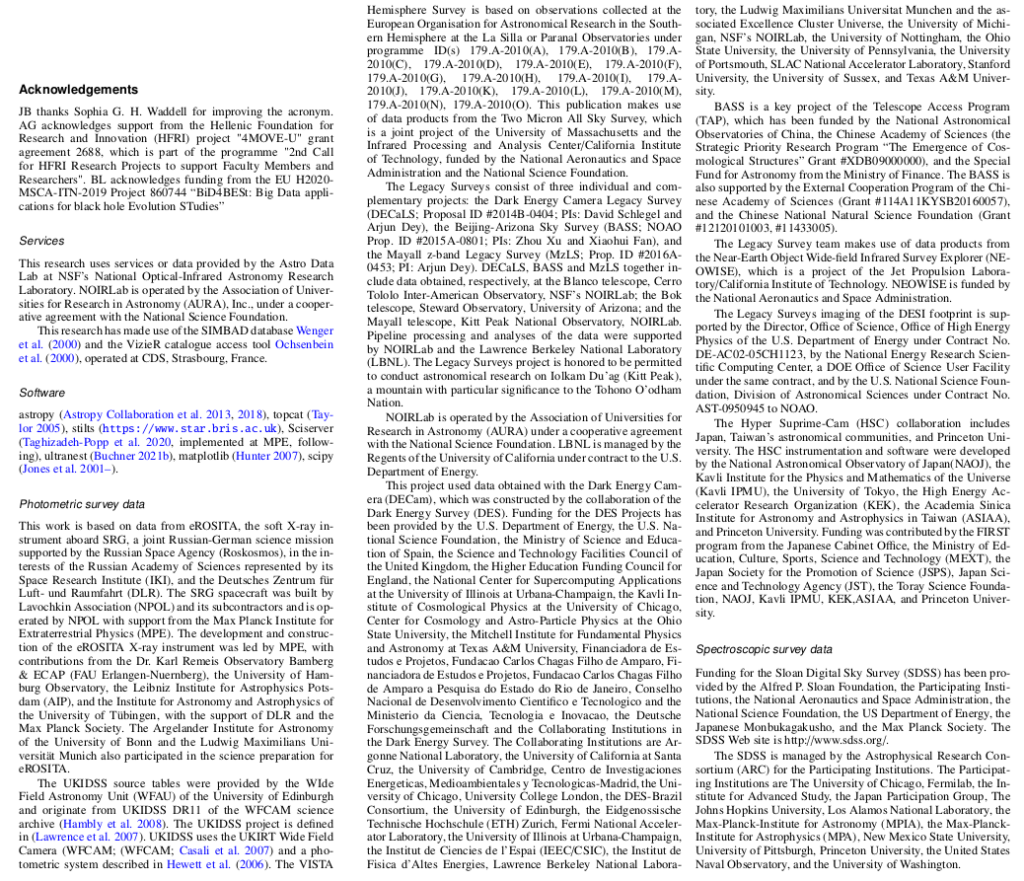
I do a lot of work on relatively old, archival observations, and that there is freely available, well-calibrated data is one of the best things of astronomy. I have acknowledged these effort with extensive citations. Here are two examples: (1) In a huge archival study of 900 gamma-ray bursts discovered by Swift, I cited over 165 Astronomer Telegrams, because they contain follow-up observations and key quantities like redshifts. (2) In a recent SED fitting paper analysing data from ultraviolet to infrared based on spectroscopically identified quasars, I spent 1.5 pages acknowledging the server infrastructure and all the surveys:
Acknowledging project-specific contributions
There are nice guidelines by some journals, that I agree with. Unfortunately, there does not seem to be a astronomy journal giving co-authorship guidelines, or at least I have not seen it.
My favorite guideline write-up is by the medical journal ICMJE, but the recommendations from Springer Nature are also similar):
Co-authorship requires:
- Substantial contributions to the conception or design of the work; or the acquisition, analysis, or interpretation of data for the work; AND
- Drafting the work or reviewing it critically for important intellectual content; AND
- Final approval of the version to be published; AND
- Agreement to be accountable for all aspects of the work in ensuring that questions related to the accuracy or integrity of any part of the work are appropriately investigated and resolved.
The forth point means, that a co-author should be able to defend the paper in a conference discussion, when someone says the study is garbage. If they don’t want to have their name on it, don’t have your name on it.
The third point implies you need to get the okay of the person to submit it with their name on it, and indeed you absolutely cannot submit a paper to a journal with people’s names without them agreeing to be co-authors. So if you are not careful, you can end up in a difficult limbo, where you have put a person’s name on the co-author list, shared drafts, they never reply, and now you cannot submit. People in permanent positions can keep you, without a permanent position, in this state forever. That’s why, in my opinion, you should never put people’s name into the co-authors list in drafts before they have sent you comments, and thereby implicitly or explicitly saying they would like to be coauthors. That is, I believe in a opt-in co-authorship policy, rather than a opt-out policy, because it avoids the stalemate. It creates an incentive to say yes and send comments.
For the second point, drafting the paper, you can help me a lot. Pointing out relevant papers to cite is a crucial contributions – literature review is a lot of work if you have the ambition to be thorough. Going beyond criticising text and providing improved text blocks is a crucial contribution for someone like me who has a hard time writing. I’m gonna love having you as a co-author if you do these, even if you did not touch the data or were in any discussion meetings.
Regarding the first point: Indirect contributions, such as holding workshops, making software and tutorials publicly available, are not part of acknowledgements or co-authorship. Maintaining the IT infrastructure of the institute is important to enable this and other project, but part of the affiliation as an implicit acknowledgement. Project-specific scientific software support that enables smooth project completion should be acknowledged. You can be as generous as you want in the acknowledgements! There is no cost and it only helps generate good will. Acknowledge reviewers, hallway discussions and encouragements. Custom code development enabling the project should count towards co-authorship.
Managing expectations: be upfront about your policy
You do not have to agree with my co-author ship policy, and I do not expect you to have my policy. But: be up-front about what your policy is. What threshold do you apply for co-authorship?
This can avoid frustration and conflicts by being upfront. I had two collaborations where I spent time in many meetings discussing the paper data analysis and interpretation, providing references from a literature review, and thought that I would be a co-author but the first author did not. Both cases were first authors from (astro)particle physics – I learned that they have a much higher threshold for co-authorship.
Personally, I think that is dumb: There is essentially no cost to including someone as a co-author. It is encouraging to continue collaborating. Can you imagine my excitement when I was included into the list of contributors to the VLC project? I became and remain a hard-core fan of the project. So err on the side of generosity. I realise, however, that telling people to be generous is futile; you can only grow the feeling of generosity by experiencing wealth, kindness and generosity from others setting an example. The counterargument that <=3 authors allows all to be named in the citation is, to be frank, pathetic.
In my most recent paper, I copied the ICMJE guidelines into the latex/overleaf as comments just above the co-author list, to be upfront. I kept a list of co-author names and their substantial contributions, but commented out until they gave comments.
Leave a Reply