Cosmology – do we need it? 😉
Large community resources are spent to precisely measure the geometry of the Universe, and detect deviation from w=-1 etc. These astronomy measurements can give hints of the behaviour of dark energy and dark matter, but not on what it is.
Closer to most extragalactic astronomy, what is the impact of cosmology parameter debates? The most common exercise is converting fluxes to luminosities given redshifted spectral lines.
I plotted the the range of highly debated curvature parameters and their impact on the luminosity distance, as blue curves in the image below. It is indistinguishable. In orange is the Hubble tension, which can impact the inferred luminosity by up to 20%.
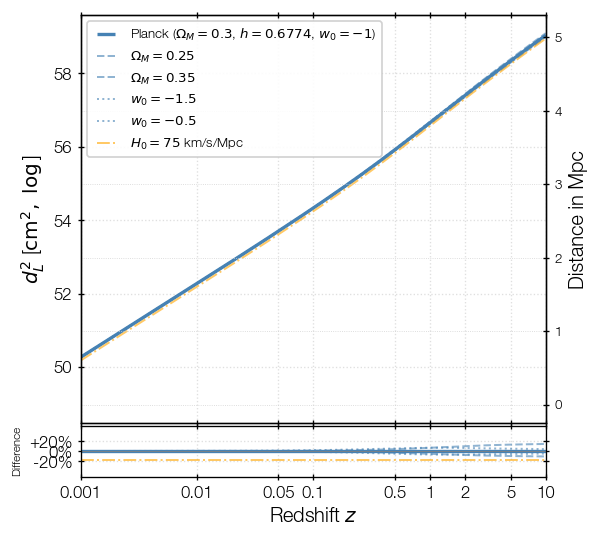
Cosmology math is complicated, usually I just use cosmolopy to calculate. But the relation looks very close to a power law, so here is a fit to low and high z ends:
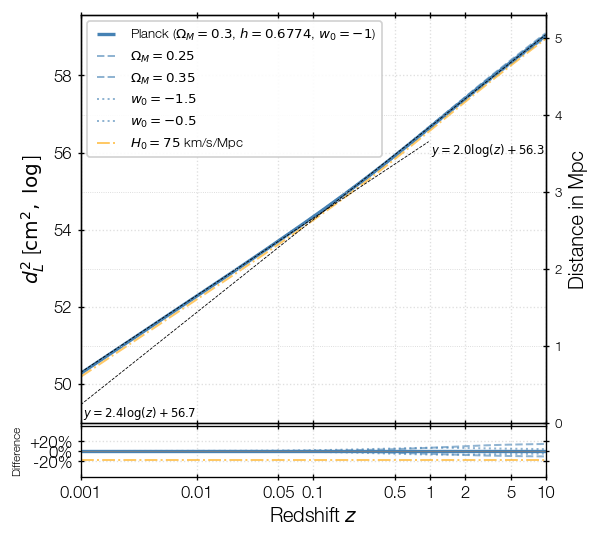
An easy finger exercise: If you have a z=1 luminosity (1e44 erg/s), you can subtract 56.3 and add 2log(z) and roughly get the flux, so 10^-12.3 erg/s/cm².
This geometric behaviour really breaks down between z=0.1 (~500Mpc) and 0.2, which is my preferred definition for the end of the “local Universe“
Cosmology research is quite useful for making optical/near-infrared ancillary data sets (looking at you, DESI and Euclid), and X-ray surveys like eROSITA 🙂
Leave a Reply