To bring humans to Moon or to Mars?
Either is a multi-decade task. This requires stable leadership and institutional knowledge. Components and people build on each other to achieve complex goals.
The moon landing was a monumental achievement. The closest mental anologies are expeditions to the north and south pole, or high-altitute human tests in the atmosphere by the military. It was a quick peek into hostile territory with a high chance of death every time. It was not the establishment of a longer-term presence.
For Antarctica, establishment of a base was the next step. In part, because of resources, military strategy. But there are also scientific experiments conducted there (South Pole Telescope for studying the Big Bang, Icecube for studying the origin of neutrinos).
Whether a longer-term presence outside Earth is the next step and which solar system body it should be on has changed over the years. Here is a chart of what NASA was directed to focus on:
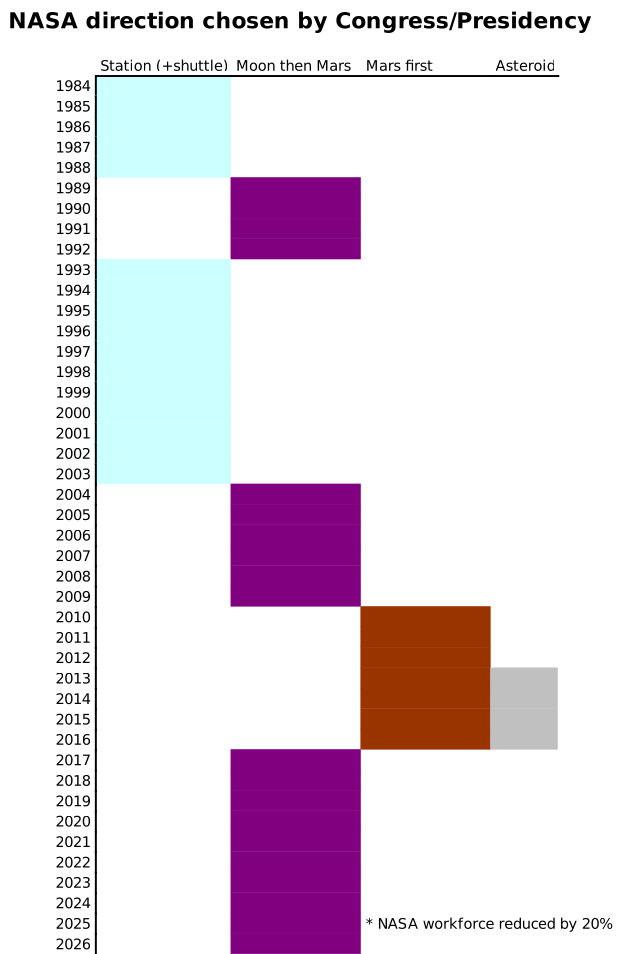
Each change in direction incurs a high cost. Tailored solutions are shelved, and expertise is lost. It matters to some degree which target is chosen, but it also matters to stick to it for decades. This is not easy in a democracy with changing leaders, and when everyone has an opinion.
Here is mine. I am not an expert in solar system exploration, or engineering rockets, space suits or bases.
The priority to choose, Mars or Moon, is flexible if you know little about what Mars and Moon are like. From Earth looking up, they are both balls where you can point rockets at. Indeed, their volume, radius, landarea is not hugely different.
Pros and cons of Mars:
+ Mars is a planet, and it sounds more romantic to have a multi-planetary society than to spread out to the moon.
– Mars soil is toxic.
– The atmosphere is very thin and does not have oxygen.
– Gravity is there but low.
– Dust storms.
– Flight time only for a return rescue mission is 9 month to 2 years .
– If we place humans there, we will contaminate the planet, and might never find out if there was ever life on Mars.
Pros and cons of the Moon:
+ Flight time only for a return rescue mission is a few days.
+ solar power all day round
+ No dust storms, but
– Asteroid impacts: every square meter there are a few per week.
– Moon dust sticks to everything with its microscopic spikes. It teared up the Apollo space suits, making them trash after a few days. Also, it causes cancer.
– No radiation protection, unless you go underground.
– No gravity.
Neither are great starting points. We can again compare to Antarctica. The temperature is similar on Mars, but Antarctica comes with breathable atmosphere, radiation protection and low rate of meteorites. I’m not saying we should stick to Antarctica, been there done that, but we should be aware on just how many fronts progress and improvements are needed.
My suggestion would be:
1) to stick to one plan
2) to let go of romantic ideas and start with an underground moon base, for example, by sealing off a large cavity (lava tube) near the poles, with permanently irradiated solar panels on a hill.
3) If anything romantic, develop self-replicating additive manufacturing.
There is also the issue of modifying an environment to create, at least for some limited area, a breathable atmosphere, and maintaining this atmosphere against failures. For the last century, we have made headway in understanding Earth’s atmosphere and its processes in great detail, and have accelerated modifications. But it has been in the inhabitable direction, driven by societal processes that we do not fully and consciously control. Practicing good stewardship of this Earth is not an alternative to Moon and Mars bases, it is a prerequisite.
Leave a Reply