Conflicts are common place when working in scientific collaborations, and with people in general, whether in private or professional settings. Be it, that others take undue credit, screw someone’s plans over, belittle contributions, are confrontational and rude, or mock someone.
Conflicts are stressful. Disappointment, anger, frustration, fear, insecurity, are intense emotions that can arise.
My gut reaction when conflicts arise — affecting me or someone else — is to avoid engaging with the conflict and hope it resolves itself. The trouble is, behaviours do not magically resolve themselves but perpetuate when left alone. The issue becomes bigger, frustration becomes bitterness, and, handling the situation is more difficult, if not impossible.
My learning over the years has been that I should do the exact opposite of what my gut tells me: When I feel there is a social uncertainty or something off, immediately communicate about it. Say “This feels off to me, what do you think?”. I find people are happy to adjust and see the point if the issue is still small!
My challenge is usually that I might not have the right words to express issues clearly. But it is more important to have the right intentions than the right word.
I have learned one lesson in one sport, which I have found to be universally applicable to most other sports.
The lesson is as follows:
Imagine your shoulder points and your hips forming a rectangle. This rectangle needs to be mobile. Start any action by moving that rectangle. Not flailing the arms and legs. Move that rectangle and be agile.
Being quick and active with your hips, and engaging with your core is also a lesson I have learned in jiujitsu. I have found it applicable in:
table tennis
volleyball
basketball
snowboarding
windsurfing
martial arts
and bringing it up to others, they have confirmed it also for tennis.
Coalitions become very unpopular when politicians are seen fighting and haggling. Calls for re-elections appear, together with the phrase “Instead of fighting all the time, the government should work.”
Elections represent the choices of the people, ideally not just in the representatives but the direction they intend to lead towards. If people were to already agree in majority, the outcome would be a single party leading the country in one direction.
If there is no party with a majority, the people are delegating the finding of a direction. On election day, this indecision is yet to be resolved. It is the job of politicians to resolve it, through consensus, compromise, conflict or otherwise.
So I see politicians of different parties fighting as the delegated resolution of the people’s conflict. They are undergoing the process.
In different countries, this may be more or less open. Perhaps in the past, in socialist countries and in dictatorships, this happens behind closed doors. Therefore, it appears orderly.
As transparency is increased, these conflicts become more visible. Maybe many people are uneasy with just the knowledge that there is a conflict ongoing. Or they may reject the style of resolving the conflict of interests. The ugliest forms are narcissistic politicians doing name calling and bullying. Alternatives, such as consensus finding, exist and may be preferable by conflict-avoiding people.
I also dislike conflicts myself, but I don’t mind delegating them to politicians to sort out.
Let’s say you are a victim of bullying. A fraction of your work place or school decides that they will feel better if they make you feel lower.
You go there every day. What fraction of people would it need to have a bad experience?
Let’s say you interact with 30 people there on average on a day. If you have a bad interaction, you will feel bad on that day and you will feel anxious the next day. So it only takes 1 in 60 people who treat you like crap, to feel like crap every single day. 98% of the people can be neutral and you will experience that place as a hostile environment.
People are cautious that they will be punished for one-off bad behaviour. Everyone makes mistakes in social interactions. That’s easy to fix! Just follow up and say something like “Hey, just wanted to make sure you are okay. I think that situation was weird. I could have handled it better.” Or say something positive and encouraging.
The psychological damage is regular behaviour that goes unaddressed. No one steps in. Bullies get positive feedback. Be a peer that does something good, even if it is just to say into the space “What happened just now is not okay.”.
Don’t be content in your life just to do no wrong, be prepared every day to try and do some good. — Sir Nicholas Winton
I don’t think running is the pinnacle of human excellence.
Marathon running is very popular among top scientists. I used to run half-marathons – rarely in events, mostly for myself – somewhat regularly at one point in my life. I want to talk about my approach to running and the advantages, drawbacks and importance of running.
One drawback is that running takes a lot of time of the week. I never aimed for Marathons, which are another level of strain on the body: I like having functional knees, thank you very much. If you use running to chase the daily runner’s high, that does not sound like a healthy practice to me, and I have two colleagues who have long-term health issues from regular, extensive sports.
If you don’t have knee or weight issues, running isn’t that hard. You place one foot before the other, and choose a pace that you find interesting, and repeat. Running has the nice side effect that advancing is pretty quick: Muscles build up, coordination improves, weight goes down, streamlining the body, running gets easier.
What if you have a bad day and running is difficult? Some people choose to run at a fixed pace (x km/h), which is really hard if you have a bad day and almost too easy if you are having a good day. Some people choose to run for a fixed duration (30 minutes), which means you run less distance when things are not aligned, and more distance when you feel good.
I prefer to run to completion a fixed length route. This means I take longer on bad days. On a treadmill, I like to choose a fixed calorie goal, and adjust the speed so that I find it challenging enough that my brain shuts off. It means I take longer on bad days and am done faster on good days. Why not reward yourself for doing well?
For me, the main benefit of running is indeed that my brain and thought generation truly becomes silent.
On phones, you cannot create new concepts. Phones can be creative for photos, but they are not for creating new ideas. They are for consuming images, films, and other people’s ideas. It is difficult to create new things until you interrupt consuming other people’s ideas.
Don’t spend your time on a device that cannot create. I rather reach for my laptop, where I can write down ideas and create new programs.
I have noticed this and have practiced it for ~10 years now.
Either is a multi-decade task. This requires stable leadership and institutional knowledge. Components and people build on each other to achieve complex goals.
The moon landing was a monumental achievement. The closest mental anologies are expeditions to the north and south pole, or high-altitute human tests in the atmosphere by the military. It was a quick peek into hostile territory with a high chance of death every time. It was not the establishment of a longer-term presence.
For Antarctica, establishment of a base was the next step. In part, because of resources, military strategy. But there are also scientific experiments conducted there (South Pole Telescope for studying the Big Bang, Icecube for studying the origin of neutrinos).
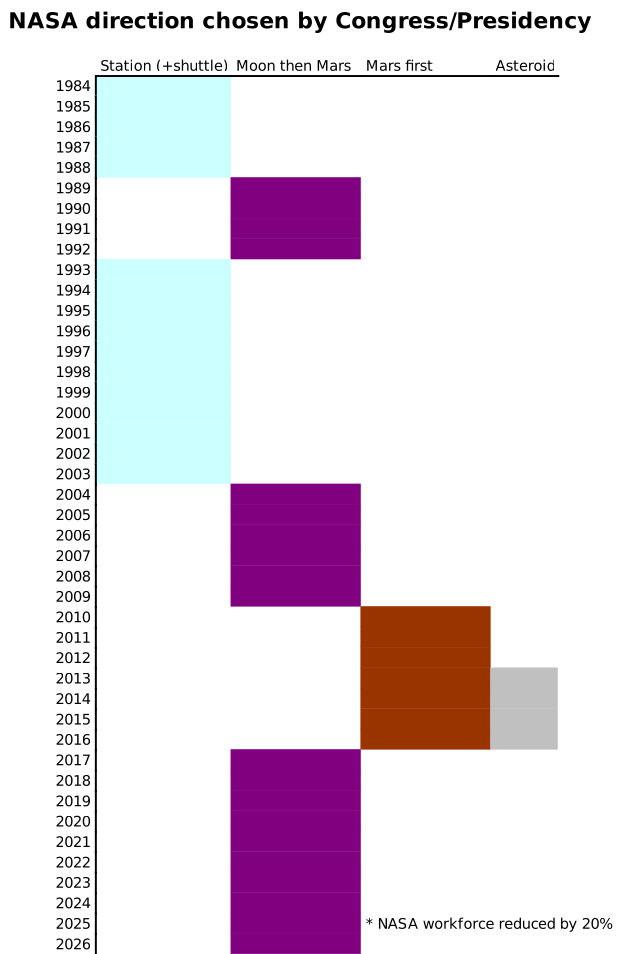
Whether a longer-term presence outside Earth is the next step and which solar system body it should be on has changed over the years. Here is a chart of what NASA was directed to focus on:
Each change in direction incurs a high cost. Tailored solutions are shelved, and expertise is lost. It matters to some degree which target is chosen, but it also matters to stick to it for decades. This is not easy in a democracy with changing leaders, and when everyone has an opinion.
Here is mine. I am not an expert in solar system exploration, or engineering rockets, space suits or bases.
The priority to choose, Mars or Moon, is flexible if you know little about what Mars and Moon are like. From Earth looking up, they are both balls where you can point rockets at. Indeed, their volume, radius, landarea is not hugely different.
Pros and cons of Mars: + Mars is a planet, and it sounds more romantic to have a multi-planetary society than to spread out to the moon. – Mars soil is toxic. – The atmosphere is very thin and does not have oxygen. – Gravity is there but low. – Dust storms. – Flight time only for a return rescue mission is 9 month to 2 years . – If we place humans there, we will contaminate the planet, and might never find out if there was ever life on Mars.
Pros and cons of the Moon: + Flight time only for a return rescue mission is a few days. + solar power all day round + No dust storms, but – Asteroid impacts: every square meter there are a few per week. – Moon dust sticks to everything with its microscopic spikes. It teared up the Apollo space suits, making them trash after a few days. Also, it causes cancer. – No radiation protection, unless you go underground. – No gravity.
Neither are great starting points. We can again compare to Antarctica. The temperature is similar on Mars, but Antarctica comes with breathable atmosphere, radiation protection and low rate of meteorites. I’m not saying we should stick to Antarctica, been there done that, but we should be aware on just how many fronts progress and improvements are needed.
My suggestion would be: 1) to stick to one plan 2) to let go of romantic ideas and start with an underground moon base, for example, by sealing off a large cavity (lava tube) near the poles, with permanently irradiated solar panels on a hill. 3) If anything romantic, develop self-replicating additive manufacturing.
There is also the issue of modifying an environment to create, at least for some limited area, a breathable atmosphere, and maintaining this atmosphere against failures. For the last century, we have made headway in understanding Earth’s atmosphere and its processes in great detail, and have accelerated modifications. But it has been in the inhabitable direction, driven by societal processes that we do not fully and consciously control. Practicing good stewardship of this Earth is not an alternative to Moon and Mars bases, it is a prerequisite.
I am not hesitant to give opinions in person. But I have been hesitant to publish them online. I feel the many eyes of astronomers, many more senior. Judging any misstep I might make. Inconsiderate thoughts and just dumb arguments.
What you put online also holds permanency. Years later, I might have a completely different, hopefully wiser and more informed opinion. Old written arguments may make me look bad.
I am writing now because I accept this. What I will write here will be imperfect, and a snapshot of my thoughts in time.
I invite you to leave comments on my posts. Feel free to correct mistakes and add with your life experience. Please be generous.